Showing posts with label entree. Show all posts

March 7, 2016

Pasta Pleaser

Pin It
Margaret's Morsels | Baked Spaghetti

The transition from winter to spring is never easy for me.  Although days are getting warmer, nights are still chilly.  This makes it challenging for me to know -- not only what to wear each day -- what to cook each night.  The weather's not cold enough for soup, chili or stew, but not warm enough for chicken salad, congealed salad or a chilled soup.  Baked Spaghetti is the perfect compromise for those nights when Mother Nature can't decide if it's winter or spring.  Baked Spaghetti isn't as hearty as my traditional spaghetti, yet it offers warmth on a chilly night via a delectable blend of spices.  Most of my recipes have a story behind them and this one is no exception.

Years ago, we belonged to a church that held a luncheon on the first Sunday of each month.  Members would bring a dish or two to share and the congregation would eat together in the fellowship hall after the church service ended.  The selection varied from month to month, but there were some dishes you could always except to see on the table:  a two layer mandarin orange cake piled high with frosting; a big bowl of banana pudding topped with meringue; a pan of piping hot, perfectly seasoned, baked spaghetti.

After enjoying baked spaghetti on more than one occasion, I found out who made the dish and asked if she would share the recipe.  She graciously did but, like many good cooks, she didn't measure the ingredients.  She gave me a list of what she put in the dish with approximate measurements and the method she used to put it together.  I eagerly bought the ingredients and made the dish a few days later.


Margaret's Morsels | Baked Spaghetti

My first attempt was good, but not as good as what she made.  Over the next few months, I tried unsuccessfully to duplicate the recipe.  My version was either too runny, too dry, too spicy or not spicy enough!  The recipe was too good to throw away, so I filed it complete with notes and revisions in a recipe box with plans to cook it again at a later date.

A couple of years later, a coworker gave me a recipe for a spaghetti casserole.  As I read the recipe, I noticed how similar it was to the recipe for baked spaghetti, except it used additional ingredients and was only seasoned with salt and pepper.  I was able to combine the two recipes, using the measurements from the spaghetti casserole with the assembly instructions from the baked spaghetti.  Figuring out the right proportion of spices was trial and error, but I finally came up with a combination that pleased everyone in my family.  If my version is too mild for your taste, you can add more chili powder and cayenne pepper; too spicy, decrease those two ingredients.

Although the spaghetti is baked, the prep work takes more time than the dish is actually in the oven.  To save time, I chop the vegetables and measure the spices ahead of time.  When I'm ready to cook, I put a pot of water on to boil for the spaghetti while I brown and drain the meat and vegetables.  Once the spaghetti is cooked and drained, I combine the ingredients in the same pot used to cook the spaghetti and let it simmer 10 minutes.  If you want, you can add a drained 8 ounce can of mushrooms to the mixture.


Margaret's Morsels | Baked Spaghetti

The mixture goes in a greased 3-quart pan and into the oven for 20 minutes. To make a cheesy version, add a cup of grated cheese on top before you put the pan in the oven.

Whether you like a little bit or a lot of heat, add the cheese or leave it plain, baked spaghetti is a quick and easy pasta dish sure to please on a cold night.

Baked Spaghetti
6 Servings

1 (7 oz.) pkg. thin spaghetti, cooked and drained
1 lb. ground beef
1/2 cup chopped onion
1/2 cup chopped green pepper
1 (14 1/2 oz.) can diced tomatoes (undrained)
1 (15 oz.) can tomato sauce
1 (8 oz.) can mushroom stems and pieces, drained (optional)
1/2 cup water
1 tsp. salt
1/2 tsp. black pepper
1/8 tsp. garlic powder
1 1/2 tsp. chili powder or to taste
1 tsp. rosemary, crushed
1/8 tsp. cayenne pepper or to taste
3 tsp. sugar
1 c. shredded cheese (optional)


Cook spaghetti according to directions on the package; drain.  While spaghetti is cooking, saute ground beef, onion and bell pepper in a skillet until meat is no longer pink and onion and green pepper are tender; drain. Combine all ingredients, except cheese, in a large pot and simmer 10 minutes.  Pour into a greased 3-quart casserole dish; sprinkle cheese on top.  Bake at 400° for 20 minutes. 

© Margaret's Morsels

January 30, 2016

Cook it Slow

Pin It
Margaret's Morsels | Swiss Steak


January is cold; a month to make and break resolutions; the month bills from Christmas start arriving.  It's also National Slow Cooking Month, something I'm slow writing about this year!

I love cooking with a slow cooker -- or what my family refers to by the trademark name -- crock-pot.  I use a crock-pot for appetizers, chili, sauces, stews, entrees, entire meals and even a sandwich.  Some of the recipes were specifically for the crock-pot but others, like the one I'm sharing today, I adapted from the oven to the crock-pot.

My husband loved eating at my mother's house.  One of the entrees she cooked that he really enjoyed was round steak smothered with onions, tomatoes and seasonings and baked a couple of hours until tender.  That entree -- Swiss Steak -- was never one of my favorites.  My mother used a lot more tomatoes and onions than I liked, plus she only added water to the ingredients which made for a flavorless gravy.  Shortly after we got married, my husband asked if I would make Swiss Steak for supper sometime.  I told him I would, but I'd need to find a recipe first.

I don't remember where I found it, but my husband deemed the first Swiss Steak recipe I tried a keeper and I've been cooking it ever since.  The recipe was actually very similar to my mother's recipe.  The round steak was pounded, coated with flour and browned in a skillet, but it used fewer tomatoes and onions and, instead of water, a jar of beef gravy.  For years, I cooked it in the oven but, on a particularly hectic day, discovered it was equally delicious cooked in a crock-pot.

One day in the late 1990s, I realized I had a late afternoon appointment the same day I'd planned to cook Swiss Steak for supper.  The meat had been thawing in the refrigerator for two days so it had to be cooked that day.  I could fix the Swiss Steak according to the recipe which would make for a very late supper, or I could try cooking it in the crock-pot.  Suppertime is always a stressful time of day for me even under the best of circumstances, so I opted for the latter.

Since crock-pot cooking is different from cooking in an oven, I had to make a few changes to the recipe.

  • I don't pound the meat because low and slow cooking in the crock-pot tenderizes even the toughest cut of meat.

Margaret's Morsels | Swiss Steak


  • The first couple of years, I skipped browning the meat because I'd read it was an unnecessary step in crock-pot cooking.  One day, on a whim, I decided to see what would happen if I browned the meat first.  I don't think browning the meat improved the flavor, but I think it made the finished product prettier.  If I have time to brown the meat, I do; if not, I don't.  It's delicious either way.

Margaret's Morsels | Swiss Steak


  • When I cook Swiss Steak in the oven, my baking pan is big enough to hold the ingredients in one layer.  Due to the size and shape of my crock-pot, I have to layer the ingredients.  To compensate for that, I put some tomatoes, onions and gravy over each layer, instead of putting everything on the top layer.

Margaret's Morsels | Swiss Steak
Two layers of ingredients.


Margaret's Morsels | Swiss Steak
Layered and ready to cook.

Cooking Swiss Steak in the crock-pot takes longer, but it makes suppertime so much easier for me.  All that's left for me to do is fix a couple of sides -- baked potatoes and steamed broccoli in the winter and fresh corn-on-the-cob and a salad in the summer -- and supper is ready.

January might be National Slow Cooking Month, but crock-pots are wonderful to use all year long.  After all, what's better than coming home to a hot cooked meal any month of the year?

Swiss Steak
4 to 6 Servings

1 (2 lb.) round steak, cut into 8 pieces
1/2 cup flour
1 tsp. salt
1/4 tsp. pepper
1/4 cup vegetable oil*
1/2 cup finely chopped onion
1 (14 1/2 oz.) can diced tomatoes
1 (12 oz.) jar beef gravy

Mix flour, salt and pepper in a large resealable plastic bag.  Add meat, two pieces at a time, tossing to coat thoroughly.  Heat oil in a large skillet.  Add meat and cook one minute; turn meat over and cook the other side for one minute.  Put a layer of meat in the crock-pot; put some onion, tomatoes and gravy over meat.  Continue layering until all ingredients are used, ending with gravy.  Cover and cook on low for 8 hours.  

*If you don't brown the meat first, omit the oil and proceed as directed.

© Margaret's Morsels 

January 19, 2016

A Taste of Germany

Pin It
Margaret's Morsels | Schnitzel

At the beginning of the year, I always like to share a healthier alternative for a traditional food.  Over the last few years, I've shared recipes for salmon patties; broccoli; pork chops; Mozzarella cheese sticks.  I want to share a recipe this January too, but we're going to have to take a little detour.

During the 2014-15 school year, my family hosted a foreign exchange student from Germany named Simon.  We enjoyed getting to know this fine young man and learning about his country's customs and culture.  In exchange, he was able to experience life in an American family, attend an American high school and try American food.  He was a good sport about trying and eating new foods, but after a few months he started missing the food from home.  When he arrived, he'd given me a German cookbook as a present.  At the time, I had him mark the recipes he liked with sticky notes and told him at some point during his stay I'd fix a German meal. When that day arrived, the first thing he wanted me to fix was schnitzel.

Schnitzel -- a thin slice of meat dipped in eggs, coated with bread crumbs and fried -- is the German equivalent of American chicken fried steak or country fried steak.  Although I'd never eaten German food before, I had heard of wiener schnitzel which is made with veal, a meat we don't eat. Simon told me schnitzel could be made with other meats, including pork which is what his family used.

Not long after that, Simon helped me interpret the recipe in the cookbook, putting it together with the way he remembered his grandmother fixing schnitzel.  We coated boneless pork chops in flour, dipped them in eggs and then coated them in plain bread crumbs.  Staying true to the recipe, we fried -- not my preferred cooking method -- the pork chops in canola oil. Unfortunately, they didn't taste like the schnitzel he ate in Germany, but like pork chops cooked in an American home.

A few weeks later, I decided to surprise Simon with schnitzel, but I changed a couple of things.  Instead of using pork chops, I sliced a pork tenderloin into pieces and pounded them flat.


Margaret's Morsels | Schnitzel


Margaret's Morsels | Schnitzel

Margaret's Morsels | Schnitzel

I coated the pieces with flour, dipped them in eggs and coated them with bread crumbs, just like I did the first time.  Instead of frying them, though, I baked them in the oven.  Simon said the schnitzel was much better than my first attempt, but it needed more seasoning.  He looked through my spice rack, smelling some of the spices, until he found what he was looking for: garlic powder and Italian seasoning.  When he showed me those spices, I knew exactly how I was going to make the schnitzel.

One cold winter night, Simon burst through the kitchen door, stopped and exclaimed, "It smells good in here!"  What he smelled was my American version of schnitzel.  Since he liked the schnitzel made with pork tenderloin, I used it again, but decided to coat it with the same ingredients I use when I make Chicken Parmesan.  I omitted the flour completely and dipped the pork in eggs and then a mixture of Italian bread crumbs, Parmesan cheese, Italian seasoning and garlic powder before baking it in the oven.  Simon loved it and ate with gusto that night!

I don't know if my version could really be called schnitzel since some of the ingredients and the baking method are different.  Regardless of what you'd call it, two things are certain.  One, it's delicious.  Two, it's a healthy entree since it's baked not fried.

I look forward to trying German cuisine -- including schnitzel -- when we go to Germany later this year.  The thing I look forward to the most, though, is seeing Simon again.  I can't wait to see how much he's grown and give him something he hasn't had since he left last June:  a hug from his American mother!

Update:  After this was posted, Simon texted me and said he didn't mind me using his name in the article.  I've revised the copy, replacing "our student" with "Simon."  I also included his name in the recipe title.  The rest of the entry remains unchanged.


Simon's Schnitzel
6 to 8 Servings

1 (1 1/4 lb.) pork tenderloin, cut into eight pieces and pounded 1/4-inch thick
3 eggs, beaten
1 cup dry Italian bread crumbs
1/3 cup grated Parmesan cheese
2 1/4 tsp. Italian seasoning
1 1/2 tsp. garlic powder

Beat the eggs in a bowl; set aside.  In another bowl, combine the bread crumbs, Parmesan cheese, Italian seasoning and garlic powder.  Dip each piece of meat in the eggs and then coat both sides thoroughly with the bread crumb mixture.  Place meat on a greased cookie sheet.  Bake at 375° for 10 minutes.  Turn meat over; bake 12 minutes more, or until thoroughly cooked. 


© Margaret's Morsels


December 31, 2014

Lucky Legumes

Pin It

Margaret's Morsels | Hoppin' John


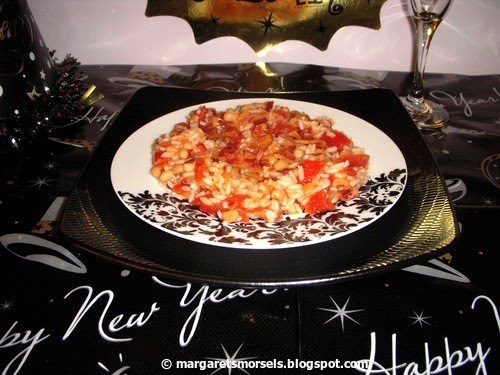
My husband isn't a superstitious person, except when it comes to New Year's Day.  For the 20 plus years we've been married, he's always requested black-eyed peas on January 1.  We live in the South and legend has it that eating black-eyed peas on New Year's Day is supposed to bring a person good luck all year long.  Black-eyed peas are my least favorite legume, but I find them palatable when served as Hoppin' John, a Southern dish made with pork, rice and, of course, black-eyed peas.  After cooking feasts on Thanksgiving and Christmas, I don't want to spend New Year's Day cooking so I take a few shortcuts.

Instead of cooking a pot of dried black-eyed peas, I substitute a can of black-eyed peas.


Margaret's Morsels | Hoppin' John


Canned black-eyed peas are already cooked so you don't have to soak or cook them.  The peas need to be drained and, since canned black-eyed peas contain a lot of salt, rinsed.

Quite a few Hoppin' John recipes use ham hock, an approximately 3-inch piece of a hog's hind leg consisting of meat, fat, bone and connective tissue which adds a lot of flavor to beans.  This recipe skips the ham hock and uses bacon instead.  I cook the bacon in my indispensable Bacon Wave microwave bacon tray which gives, as advertised on the box, "The frying pan taste without the frying pan."


Margaret's Morsels | Hoppin' John


The bacon grease collects in the bottom of the tray and can easily be poured into a saucepan and used to saute the onion.

No matter what I cook, I like to do as much prep work ahead of time as possible.  There's not much I can do ahead of time with this recipe, other than cook the rice and put it in the refrigerator.  The rice is reheated when it's added to the saucepan with the other ingredients.


Margaret's Morsels | Hoppin' John


Not all Hoppin' John recipes use tomatoes.  I like to add them because they add a pop of color to the finished dish.  Some recipes call for garnishing Hoppin' John with diced fresh tomatoes.  Other recipes call for stirring a can of diced tomatoes into the mixture.  Instead of fresh or canned diced tomatoes, the recipe I'm sharing today calls for a can of stewed tomatoes. Canned diced tomatoes and stewed tomatoes are not the same thing.


Margaret's Morsels | Hoppin' John

Unlike diced tomatoes, stewed tomatoes are cooked before being canned. Stewed tomatoes are also flavored with herbs and spices.  Regular or classic stewed tomatoes contain bell pepper, onion and celery.  Mexican stewed tomatoes contain jalapeno, garlic and onion; Italian stewed tomatoes contain basil, garlic and oregano.  I don't recommend using Mexican or Italian stewed tomatoes in this recipe because it will give the finished dish an entirely different taste.  Another difference is diced tomatoes are -- like the name implies -- diced.  Stewed tomatoes are usually halved.


Margaret's Morsels | Hoppin' John

The easiest way to cut stewed tomatoes into smaller pieces is with a pair of kitchen shears.

This Hoppin' John is seasoned with Tabasco, garlic powder and pepper. You can skip the Tabasco, but I recommend adding it because it keeps the dish from being bland.  This is the only recipe I have that uses Tabasco and the only reason I have a bottle in my cupboard!  You don't need to add salt; the bacon and rice add enough.

Black-eyed peas are often served on New Year's Day with greens such as collard, turnip or mustard which, because of their green color, symbolize money.  We're not fans of greens so I don't fix them.  I keep the meal simple and serve Hoppin' John with corn muffins made from a packaged mix.

I'll never like black-eyed peas as much as my husband does.  However, after the year I've had, I'll gladly eat a plate of them New Year's Day, especially if it means better luck is in store for 2015!


Margaret's Morsels | Hoppin' John


Hoppin' John
6 Servings

3 slices bacon, cooked and crumbled (reserve drippings)
1/2 cup chopped onion
1 (15 1/2 oz.) can black-eyed peas, drained and rinsed
1 (14 1/2 oz.) can stewed tomatoes (undrained), chopped
1 1/2 cups cooked rice
1/4 tsp. Tabasco
1/8 tsp. garlic powder
1/8 tsp. pepper

Saute onion in bacon drippings until tender; drain onion and discard drippings.  Return onion to saucepan.  Add remaining ingredients, except the bacon.  Cover and cook on low heat 8 to 10 minutes.  Spoon into a serving dish; sprinkle crumbled bacon over top.

© Margaret's Morsels


April 17, 2014

Hamming it Up

Pin It
Margaret's Morsels | Canned Ham

I always serve ham at Easter and this year is no exception.  However, I'm not preparing a shank portion like I normally do.  I'm only cooking for five people so I don't need that much ham.  Due to a time constraint of one of the guests, I need to have supper on the table at 5:30.  This is going to be challenging since I won't start cooking the ham until we get home from church.  I could cook the ham the day before and reheat it when we're ready to eat, but I don't like that idea.  Buying an already cooked spiral ham isn't an option because my family doesn't like them.  Fortunately, there's another choice.  This year, I'll be serving a canned ham for Easter.

Canned ham is exactly what it sounds like:  ham that is sold in a can.

Margaret's Morsels | Canned Ham

The ham is either from a boneless piece of meat, or pieces that have been combined and are held together with a gelatin mixture.  The brand I buy comes in three and five pound sizes, but the larger size is sometimes hard for me to find.  Canned hams are fully cooked and, as such, don't require additional cooking.  However, the flavor is greatly improved by heating. 

There are two varieties of canned hams:  shelf stable and refrigerated. Shelf stable canned hams have been processed at high temperatures which allow them to be stored at room temperature.  This processing, which gives the ham a long shelf life, also makes the product less flavorful than its counterpart.  I avoid shelf stable canned hams and only purchase those that are refrigerated.  The taste and texture of a refrigerated canned ham are a little different from traditional ham, but that's a small price to pay for the convenience.  Unlike a shank or butt portion that can take hours to cook, a canned ham is ready in an hour.  It can also be cooked in a crock-pot which frees up the oven for side dishes and rolls.

Just because it's a canned ham doesn't mean it has to be served plain.  I serve it that way because that's how my family likes ham.  Canned hams -- like regular hams -- can be dressed up with the addition of fruit, liquid smoke or glazes.  A search on the Internet will yield lots of recipes and ideas for using canned hams.

Although I may take a shortcut with the ham this year, the rest of our Easter dinner will be the same as every year:  macaroni and cheese, green bean bundles, deviled eggscranberry orange relish, homemade rolls, an Easter bunny cake and, to wash it all down, a refreshing pitcher of fruit tea.

Canned ham might not be the first thing you think of serving for Easter, but it is an easy and tasty alternative when time is short, you don't need to feed a large crowd and you still want to ham it up!

Margaret's Morsels | Canned Ham

Baked Canned Ham
6 to 8 Servings

1 (3 lb.) canned ham
1/2 cup water

To Bake in the Oven:  Remove ham from can and place in baking pan. Add 1/2 cup water to pan.  Cover pan with foil and bake at 325° for 1 hour, or until meat thermometer inserted in center reads 135°.

To Cook in a Crock-Pot:  Pour 1/2 cup water in bottom of crock-pot.  Wrap ham in foil; place in crock-pot.  Cover and cook on high 1 hour.  Reduce heat to low and cook 6 to 7 hours, or until ham is heated through.

© Margaret's Morsels

January 28, 2014

Marvelous Meat Loaf

Pin It
Margaret's Morsels | Sweet and Sour Meat Loaf

A couple of years ago, my brother, who was visiting from out of town, was sitting in the kitchen while I fixed supper.  He asked what I was cooking and I replied, "Meat loaf."  He was silent for a moment and then asked, "Are you using mom's recipe?"  I laughed and told him I wasn't.  From my peripheral vision, I detected a sigh of relief.  Our mother was a wonderful cook, but there were two dishes she made that left a lot to be desired. One was macaroni and cheese; the other, meat loaf.

After I got married, I tried numerous meat loaf recipes and, although more flavorful than what my mother used to make, none were good enough to earn a regular rotation on our dinner table.

Ten years ago, after I got home from having surgery, a friend brought us a delicious dinner that included meat loaf.  It was the best meat loaf I'd ever eaten!  She shared the recipe with me and I've been making it ever since. I still remember how nourishing that meat loaf was to both body and soul so, when my husband had surgery last week and asked me to make meat loaf for him post op, how could I refuse?

Sweet and Sour Meat Loaf uses a lot of the same ingredients as my mother's recipe.  So why was my friend's meat loaf better?  Like most food, personal preference plays a role, but it also comes down to what is and isn't in the meat loaf.  Let's look at the anatomy of a meat loaf.
  • Meat:  The main ingredient is ground meat.  The meat can be beef, pork, turkey, lamb or a combination of meats.

Margaret's Morsels | Sweet and Sour Meat Loaf

  • Vegetables:  Chopped onion, green pepper, celery, carrots, mushrooms or canned diced tomatoes are common additions. They add flavor and, depending on the size, texture.

   
Margaret's Morsels | Sweet and Sour Meat Loaf


  • Liquid:  Liquid is needed to keep the meat loaf moist.  Water, milk, beef broth, catsup, barbecue sauce, tomato sauce or Worcestershire sauce are often used.

Margaret's Morsels | Sweet and Sour Meat Loaf

  • Binding:  These are the ingredients that keep the meat loaf from falling apart.  Eggs are traditionally used in combination with bread crumbs, oats, crushed crackers or uncooked packaged stuffing mix.

Margaret's Morsels | Sweet and Sour Meat Loaf


  • Seasonings:  You can season meat loaf with herbs and spices you like, but make sure whatever you use goes well with the rest of the ingredients.

Margaret's Morsels | Sweet and Sour Meat Loaf

These five elements are true of every meat loaf recipe I've ever tried. However, some recipes call for additional elements.
  • Filling:  Cheese or other ingredients are often placed in the middle of the meat loaf.  Half the meat mixture goes in the baking pan, the filling is added and then topped with the rest of the meat mixture.
  • Topping:  Toppings can range from as simple as a jar of brown gravy or a squirt of catsup, to bacon strips draped across the loaf, to a combination of ingredients that can be added at the beginning or towards the end of the cooking time.
No matter what ingredients you put in meat loaf, the best way to mix it up is with your hands.  It's messy, but it's the best way to tell when all the ingredients are combined.  This is important because you don't want to overmix the ingredients.  Overmixing produces a tough meat loaf.

Margaret's Morsels | Sweet and Sour Meat Loaf


Once the ingredients are combined, they can be baked in a square pan, loaf pan (regular or miniature), muffin tins or shaped by hand into an oval shape and baked in whatever size pan you have.  Depending on the size pan you use, you may need to increase or decrease the baking time.  I like to bake meat loaf in a 9-inch square pan.  When I serve it to company, though, I like to use a meat loaf pan.

Margaret's Morsels | Sweet and Sour Meat Loaf


A meat loaf pan is nothing more than a loaf pan with a removable rack.   The rack serves two purposes.  One, it allows the fat to drain from the meat while cooking.  Two, the handles on the rack make it easy to lift the meat loaf from the pan and transfer it to a serving platter. 

Margaret's Morsels | Sweet and Sour Meat Loaf


My friend's recipe doesn't use a filling, but it does use a delicious topping that is added the last 10 minutes of cooking.  The topping is made with tomato sauce, brown sugar, apple cider vinegar, granulated sugar and Dijon mustard, but it can be customized to suit your taste.  If you want it sweeter, use more sugar; spicier, use more Dijon mustard.  Through trial and error, I found that we prefer the topping with less vinegar and granulated sugar than called for in the original recipe.

Sweet and Sour Meat Loaf is an easy recipe to make on a busy day, but also fancy enough to serve to company.  It's a nice comfort food to take someone who's had a baby, lost a loved one or, like my husband, is recuperating from surgery.

Sweet and Sour Meat Loaf
6 Servings

1 1/2 lb. ground beef
1/2 cup chopped onion
1 (8 oz.) can tomato sauce
1 cup oats (uncooked)
2 eggs
1 tsp. salt
1/4 tsp. pepper

Topping:

1 (8 oz.) can tomato sauce
2 Tbsp. brown sugar
2 Tbsp. apple cider vinegar (I use 1 Tbsp.)
1/2 cup sugar (I use 1/4 cup)
2 tsp. Dijon mustard

Combine meat loaf ingredients in a large bowl.  Mix well and put in a greased baking pan.  Bake at 350° for 50 minutes.  Combine topping ingredients in a small saucepan; bring to a boil.  Pour over meat loaf and bake an additional 10 minutes.

© Margaret's Morsels

December 31, 2013

Best of 2013

Pin It
This is the time of year when TV news shows and newspapers have stories that highlight the year in review.  With that in mind, I thought I'd count down the top 10 most viewed recipes I posted during 2013. Some of the top 10 came as a surprise, but none more than the recipe that took the number one spot.  I almost didn't post the recipe because I was afraid it wouldn't appeal to many people.  I'm glad this old family favorite was a hit with my readers!  

10.  Strawberry Delight Cake:  A cake recipe that doesn't require any baking!  It doesn't get much easier than that!

Margaret's Morsels | Strawberry Delight Cake


9.  Peanut Butter Fudge:  If you think you can't make candy, think again! There's no cooking involved, unless softening ingredients in a microwave counts as cooking!

Margaret's Morsels | Peanut Butter Fudge


8.  Carrot Cake:  This cake takes some time to make, but it's worth the effort!  Unlike most carrot cake recipes, this one doesn't use pineapple.

Margaret's Morsels | Carrot Cake


7.  Chocolate Dream Pie:  A chocoholics dream.  A pie that only uses four ingredients and half of them are chocolate!  

Margaret's Morsels | Chocolate Dream Pie


6.  Chicken Parmesan:  This version is baked not fried.  It's also kid friendly, delicious and ready in under an hour!

Margaret's Morsels | Chicken Parmesan


5.  Salisbury Steak:  A tasty one dish recipe that turns ground beef from ho hum to wow!

Margaret's Morsels | Salisbury Steak


4.  Cherry Pie Filling Salad:  This versatile dish can be served as a salad or dessert.  It can also be frozen in paper baking cups for a cold treat on a hot summer day!

Margaret's Morsels | Cherry Pie Filling Salad


3. Unfried Refried Beans:  These beans look and taste like refried beans, but there's a twist.  They're not fried at all!

Margaret's Morsels | Unfried Refried Beans


2.  Eggs Benedict Casserole:  You don't have to poach a single egg to make this version of Eggs Benedict.  With this recipe, it's easy to make brunch for a bunch!

Margaret's Morsels | Eggs Benedict Casserole


1.  Loaf Cake:  This unfrosted, made from scratch, plain pound cake made with my grandmother's recipe was the most popular recipe I posted this year.  It's an oldie, but goodie!

Margaret's Morsels | Loaf Cake


As 2013 draws to a close, I want to thank everyone for reading Margaret's Morsels.  I especially appreciate the comments, emails and feedback. This interaction is what makes sharing the recipes worthwhile!  This year was challenging on several levels and I wasn't able to post as frequently as I wanted.  Hopefully, I'll be sharing a lot more recipes in 2014.  My husband gave me a 35mm camera with lenses and some other blogging necessities for Christmas, so I have some things in mind for Margaret's Morsels in 2014.  In the meantime, 
HAPPY NEW YEAR FROM MY KITCHEN TO YOURS!!!!!

© Margaret's Morsels